
Jacksonville Slip and Fall Lawyer
A premises liability claim holds a property owner responsible when an unsafe condition injures a lawful visitor. In a Florida slip and fall involving a transitory substance on a business floor, Florida Statute §768.0755 requires proof the business knew or should have known about the hazard — which makes early evidence critical.
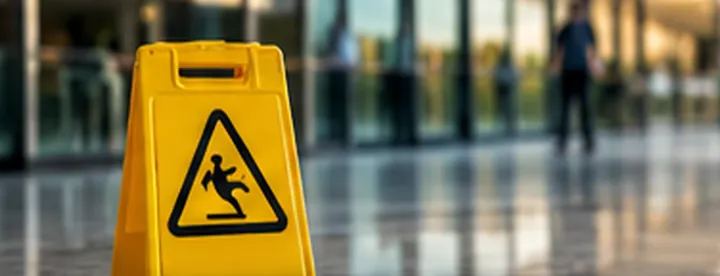
Property owners are not automatically liable
A common assumption is that being injured on someone else's property means that owner owes you money. Florida law is narrower than that. The owner's duty depends on why you were there, and in the most common scenario — a fall on a wet floor in a store — the statute imposes a specific and demanding proof requirement.
Florida distinguishes between invitees (customers and others invited for the owner's business purposes, who are owed the highest duty: reasonable care to maintain the premises and to warn of known hazards), licensees (social guests), and trespassers (owed far less).
The knowledge requirement in slip and fall cases
Florida Statute §768.0755 governs falls caused by a transitory foreign substance in a business establishment. It requires the injured person to prove the business knew or should have known about the dangerous condition and should have taken action.
Constructive knowledge can be established by circumstantial evidence showing either:
- the condition existed for such a length of time that the business should have discovered it in the exercise of ordinary care — which is why the state of the spill matters enormously (dirty, tracked-through, with cart tracks or dried edges, versus clean and fresh); or
- the condition occurred with regularity and was therefore foreseeable — a recurring leak, a produce misting system, a perpetually wet entryway in Florida afternoon rain.
This is the battleground in nearly every fall case, and it is why the first hours matter more here than in almost any other kind of injury claim.
What to do immediately after a fall
- Report it before you leave and ask for a written incident report. Request a copy; you may not get one, but ask.
- Photograph the hazard itself — the actual substance on the floor, from several angles, with something for scale. Within minutes it will be mopped and gone forever.
- Photograph the surroundings — missing warning cones, the lighting, the mats, the drainage.
- Photograph your shoes. Expect an argument that your footwear caused the fall.
- Get witness names and numbers. Other customers leave and are never identified again.
- Note every camera you can see. This tells your attorney what to demand.
- Get medical attention, and say you fell and where.
Beyond slip and falls
Premises liability covers more than wet floors:
- Trip hazards — uneven sidewalks, unmarked level changes, torn carpet, parking lot potholes.
- Inadequate maintenance — broken handrails, defective stairs, failed balcony railings.
- Falling merchandise in warehouse-format stores.
- Swimming pool incidents, including inadequate fencing.
- Negligent security — where a foreseeable criminal assault occurs on poorly secured property. These claims are fact-intensive and turn on the history of similar incidents in the area.
Why these cases are defended so hard
National retailers treat fall claims as a category to be managed, with established defense counsel, in-house protocols, and a strong incentive to contest every one. They will argue the hazard was open and obvious, that you were distracted, that your shoes were inappropriate, or that nobody can say how long the spill was there. The comparative fault rule under §768.81 gives them every reason to try.
Meeting that takes early evidence and an attorney who is actually working the file. Donald sends the preservation demand himself, in the first days, because footage lost is not recoverable later.
Related pages
Frequently asked questions
- What do I have to prove in a Florida slip and fall?
- Where you slipped on a transitory foreign substance in a business establishment, Fla. Stat. §768.0755 requires proof that the business had actual or constructive knowledge of the dangerous condition. Constructive knowledge can be shown by evidence the condition existed long enough that the business should have discovered it, or that it occurred with regularity and was foreseeable.
- Does the store have to keep the security video?
- Not indefinitely, and many systems overwrite within days or weeks. This is the single most time-sensitive part of a fall case: a written preservation demand sent early is often what keeps the footage from disappearing in the ordinary course of business.
- What if I did not report the fall right away?
- It makes the case harder, not impossible. An unreported fall invites the argument that it did not happen as described or did not happen there at all. Receipts, witnesses, medical records, and your own photographs can still establish it.
Talk to Donald Metcalf directly
When you call this office, you are not routed to a case manager. Donald handles every case personally, start to finish.